New Abilene historical marker honors 1922 lynching victim Grover C. Everett
By Floyd Miller/West Txas Tribune
You can pass laws, but you cannot regulate the heart of men.
That truth was at the center of a ceremony Saturday honoring Grover C. Everett, a Black man lynched in Abilene in 1922 — a man who looked into the face of evil.
In 1865, word of freedom finally reached enslaved Black Texans in Galveston, marking the day now recognized as Juneteenth. Fifty-seven years later, Everett, according to historical records, was working in Abilene as part of a labor crew, providing for his family.
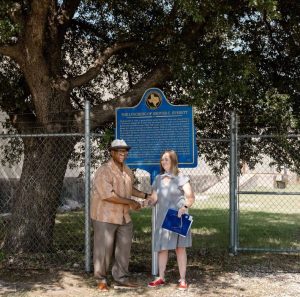
After much work and anticipation Amy Boone and Rev. Andrew Penns, a historian of Black History in Abilene, stand by the historical marker that Boone worked to bring to Abilene. (Photo by Hannah Rebekah Creative)
Amy Boone, the Abilene resident who led the push to memorialize Everett, said that one evening, after Everett returned from work, Klansmen arrived at the Joe Davis Motel and asked owner Joe Davis where Everett was.
“There was some sort (of) brief verbal exchange, but that was it,” Boone said. “The Klansmen began walking upstairs. Joe Davis tried to follow them up, and the Klansmen, according to records, said, ‘You need to just go away, you have no business here.’”
Boone said witnesses heard one gunshot before the men fled in a car.
“Joe Davis, and there were about three other Black witnesses, all found Mr. Everett dead in the hallway, coming outside of his room,” Boone said. “It is unknown as to why this happened, which obviously, as we know, is truly the definition of lynching. It’s an extrajudicial killing that is racially motivated.”
That was in 1922. One hundred and four years later, on June 20, 2026, Everett received public recognition — not just as a name in a record, but as a man whose life meant something. A historical marker describing the lynching and honoring Everett was unveiled across the street from the location where he died.
The dedication was a joint effort between the Equal Justice Initiative of Montgomery Alabama, Taylor County Community Remembrance Project and Boone, a local citizen who took it upon herself to ensure this part of history was not erased.
The push to memorialize Everett dates to 2019, when McMurry University professor Robert Wallace and several students became interested in a project by the Equal Justice Initiative, which maintains historical records and a memorial in Montgomery honoring lynching victims by county. Boone said the research led to the discovery that Taylor County was represented at the Montgomery memorial.
A community ceremony to collect soil from the site — a step in the EJI’s remembrance process — was scheduled for a weekend in April 2019, Boone said, but flooding postponed it a week. She said she had planned to attend but was out of town the following weekend and missed the ceremony.
Boone said she returned to the project after a local Black history bus tour organized by Abilene Christian University stopped at the Ash Street site last February, reminding her of the unfinished effort. She said a broader concern about the erasure of historical events also motivated her.
“I began to feel very alarmed by the amount of erasure that seemed to be happening widespread,” Boone said. “I don’t have any power over what’s happening at the federal level. I frankly don’t have any power over what’s happening at the local level, but I just wondered to myself, what can actually be done to make sure that important people and events are not erased here locally.”
Boone said she contacted Wallace, who was planning to retire and encouraged her to take over the project.
“He said that he was going to be retiring soon, and he said, ‘Wow, I would love it if you would just take the reins and go for it,’” Boone said.
She then reached out to others involved in the 2019 effort, formed a coalition of Abilene residents at the recommendation of the EJI, and worked with an EJI contact toward installing the marker.
Boone said the response from the community has been largely positive, citing conversations with curators at the Grace Museum, which previously held an Abilene Black history exhibit and panel discussion, and with the Rev. Andrew Penns and Terrence Penns at the Curtis House, which houses much of Abilene’s Black history and one of the soil jars collected for the EJI memorial.
“They told me that the whole time that that exhibit was up, it was extremely well received,” Boone said of the Grace Museum curators.
She said the Curtis House, “… also said the same, that it’s always very well received, and people are very somber and thoughtful about what this means in the community.”
About 100 people gathered at the corner of Fourth and Ash streets for the dedication. The Rev. Jeremy Jay performed “A Change Is Gonna Come” during the ceremony, followed by a song from Susan Petty. Dr. Malcolm Scott and Jean Carroll read the historical marker aloud. The Rev. Andrew Penns closed the ceremony with a prayer.

Jeremy Jay sings “A Change Is Gonna Come” at the event honoring Grover C. Everett, a Black man who was lynched in Abilene in 1922. (Photo By Hannah Rebekah Creative)
“Singing ‘A Change Is Gonna Come’ at the dedication gave me a healthy reminder that hope still works,” Jay said. “Seeing so many people of different races at the unveiling proves that love will win in the end.”
Petty, who performed “Blowin’ in the Wind,” said she found herself reflecting on the song’s opening question about how far a person must travel before being recognized for their value to society.
“Thinking about how it was growing up in the ’50s and how life was and how careful you had to be of your surroundings,” Petty said.
She said the community has made significant progress but cautioned against complacency.
“We have come a long ways, but we haven’t reached the final destination yet,” Petty said. “We have to be careful that we don’t slip backwards.”
Scott said reading the marker on Juneteenth gave the moment special significance, connecting the celebration of freedom and emancipation with the difficult reality that racial violence and injustice continued long after slavery ended.
“The marker serves as an important reminder that communities must confront painful chapters of their history rather than forget them,” Scott said. “Reflecting on Everett’s life and tragic death deepened my appreciation for the importance of historical truth, remembrance, and the ongoing pursuit of justice and equality.”
He added that community should be about “caring, curing and changing past and present harms, so that we can all live without fear in a more just and equitable future.”
Carroll said she was deeply honored to take part in the remembrance.
“I was deeply honored to be able to contribute to the remembrance of Grover Everett,” Carroll said. “I was moved by the whole ceremony, and looking out into the crowd as I read it was inspiring to see the community turn up for the unveiling of the marker.”
“Public memory is so important in times like this,” she said, “and I am grateful to be a part of a community committed to sharing this story.”
Penns said he was moved after hearing Petty and Jay each sing before he offered the closing prayer.
“The emotion of the people who were present was very positive, and I felt the presence of God, the Holy Spirit, to pray a prayer of remembrance, continued racial healing, forgiveness and a moment of celebration for what had been accomplished,” Penns said.
He also thanked Boone for her faithful commitment to the project.
Following the solemn ceremony, refreshments were served at the Curtis Cultural House, which holds a jar of soil collected from the site where Everett was killed.
A second jar of soil from that same site is held at the Equal Justice Initiative museum in Montgomery, Alabama.
Terrence Penns, curator at the Curtis House Cultural Center, said the dedication brought a sense of closure.
“For me, though, (it) felt like closure for those people who put in the work to make this all possible,” he said.
Asked about the jar of soil housed at the center, Penns said it serves as a lasting reminder.
“The soil reminds me to reflect and stay vigilant,” he said.
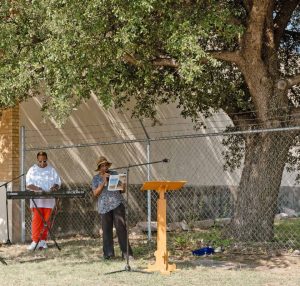
Susan Petty sings “Blowin’ in the Wind” at the unveiling of the historical marker honoring Grover C. Everett, who was lynched in Abilene in 1922. The marker is located across the street from where the lynching took place. (Photo By Hannah Rebekah Creative )