Flying Bison bring back local minor league baseball
By Clay Landen Harris
Abilene’s first minor league baseball team was established shortly after the conclusion of World War II. From 1946 to 1957, Abilene was home to the Blue Sox. They were an affiliate of the Brooklyn Dodgers (1946-48) and the Kansas City Athletics (1956-57).
The team played in a rare night-ready stadium located where H-E-B currently stands. That ballpark was razed after the league folded in 1957.
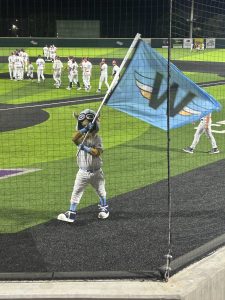
Bomber, the Flying Bison’s mascot, waves the victory flag at the 2026 Flying Bison Home Opener at ACU on June 4. They defeated the San Antonio River Monsters 4-1. (Photo by Clay Landen Harris )
The Key City then went 38 years without a semi-professional baseball team, until 1995 when the Prairie Dogs began playing at Abilene Christian University’s Crutcher Scott Field. They played in the Texas-Louisiana league until 1999, then vanished and returned for one more season in 2012, playing in the North American League at McMurry University’s Walt Driggers Field.
Abilene baseball fans have since pined for the return of a minor league ball club, and that hope was completed in 2024 with the formation of the Flying Bison — a collegiate summer baseball organization that instantly became one of the city’s most unique and exciting attractions.
The Flying Bison began in the Mid-American League, reconnecting the Big Country with its rich baseball roots. After two years playing at Walt Driggers Field in the Mid-American league — in which they heartbreakingly lost the rubber games of the championship series both years — they have now come full diamond and have returned to ACU’s Crutcher Scott Field at Bullcock Brother’s Ballpark.
This past February the Flying Bison held their third annual “Bison Bash” at the Double Tree downtown. It was inspiring, with the ownership, players, coaches, mascots, lots of free gear, a prize wheel, ballpark-themed food and drink, a DIY craft station, an explanation of the team’
The Flying Bison have a special, respectable and symbolic identity. The team’s name is inspired by the famous flying bison statue at Frontier Texas!
The branding also pays tribute to Dyess Air Force Base. The result is a thoughtfully cool logo that blends West Texas heritage, aviation, and classic wooden bat baseball.
And from this moniker there is manifested at the games a gracious mascot that is a fan favorite — Bomber. Like Captain, the Texas Ranger’s equestrian mascot, Bomber will wave a giant flag at home plate after a victory. And though not at every single game like B1 Bomber, sometimes the audience is treated to a special appearance by his little sister, Beau.
There is a recognition and a camaraderie at the games that is light-hearted, yet meaningful; from Bomber immediately raising his costume fist to meet your respect-knuckles, to recurring allies in the seats.
From the beginning, before the big innings, the organization has focused on far more than wins and losses. Attendees enjoy theme nights, collectible giveaways, the T-shirt cannon, fireworks, and many mid-inning, humorous contests.
The concession stand race is a timeless tradition, where four youth sprint down the right-field foul line dressed as a pretzel, popcorn, hamburger and a hot dog.
The emphasis on wholesome entertainment has helped the Flying Bison create a positive atmosphere that appeals to all degrees of the “Flying Faithful” — from the most dedicated baseball enthusiast, using a tiny pencil to meticulously record each at bat on their scorecard, to the casual spectator who doesn’t know the inning or the score.
The atmosphere is both cozy and thrilling. Every game offers a genuine opportunity for friends, family, strangers, locals and visitors, to come together and celebrate America’s pastime.
On the field and in the dugout, the Flying Bison squad has shown sportsmanship, talent, brotherly love, and a quitless attitude. Their Texas Collegiate League roster features athletes from across the country, giving many deserving players an opportunity to continue developing their skills, competing on the lowest plane of the highest level.
This season consists of a 48-game schedule, with eight teams playing three two-game series every week in June/July, with Monday as the league’s off day. The playoffs will take place the last week in July and into the first week of August. If you can’t make it to the ballpark, you can catch every pitch by tuning into 1340 AM.
At the deadline, The Flying Bison had played 13 games, for a 7-6 record. They have been rained out four times. They are currently in third place. The other seven franchises include the Acadiana Cane Cutters, Baton Rouge Rougarou, Brazos Valley Bombers, Lake Charles Gumbeaux Gators, San Antonio River Monsters, Sherman Shadowcats and Victoria Generals.
As the Flying Bison continue to grow, they are doing more than just running a business and running the bases, they are creating new traditions upon old traditions, strengthening our eclectic community, and providing competitive game competition. Watching them is a historical, grateful and optimistic experience.
Once again, minor league baseball is back in the Big Country, and while other ball clubs have come and gone, this team’s story is just beginning.