Walking through Greenwood: What Black Wall Street taught me at 50
By Mashall Lowry
May 14–16, 2026, was a very emotional and eye-opening week for me as I walked through the Greenwood District in Tulsa. As a young Black woman from Abilene, I realize there is so much history I was never taught or fully understood. Although Abilene has faced its own struggles, learning the history of Tulsa made me feel both heartbroken and grateful.
The Greenwood District was established in the early 1900s and became a thriving community filled with Black-owned businesses, wealth and culture. Thanks to a visionary man named O. W. Gurley, 40 acres of land were purchased and sold exclusively to Black families.
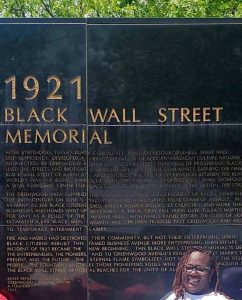
Mashall Lowry visited the 1921 Black Wall Street Memorial in the Greenwood District of Tulsa, Oklahoma, to learn more about the victims of the Tulsa Race Massacre.
One of the biggest lessons I’ve learned was the selflessness of African Americans during that time. Mr. Gurley could have kept the land for himself and his family, but instead, he chose to create opportunities for others to build wealth and success.
I sometimes wonder if our generation still carries that same spirit of selflessness today.
The Greenwood District, also known as “Black Wall Street,” became one of the most prosperous Black communities in America. Black residents owned businesses, property and land rich with oil. After enduring slavery, discrimination and war, many families were finally experiencing success and stability.
As author Hannibal B. Johnson stated, “Gurley is credited with having the first Black business in Greenwood in 1906. He had a vision to create something for Black people by Black people.”
Another important piece of history took place in 1921, when a 19-year-old Black man named Dick Rowland was accused of assaulting a 17-year-old white girl named Sarah Page. When white mobs demanded Rowland be turned over to them, the sheriff refused.
Black men, including veterans, went to the courthouse to protect him and prevent a lynching. Sadly, that moment sparked what became known as the Tulsa Race Massacre.
A mob of nearly 1,500 white men looted, burned and destroyed the Greenwood District. Sitting in history classes recently at Langston University made me deeply emotional. I could only imagine the pain and heartbreak of watching everything they worked so hard to build disappear in a matter of hours.
Yet my sadness quickly turned into admiration as I learned how Black residents refused to give up. Despite the destruction, they rebuilt.
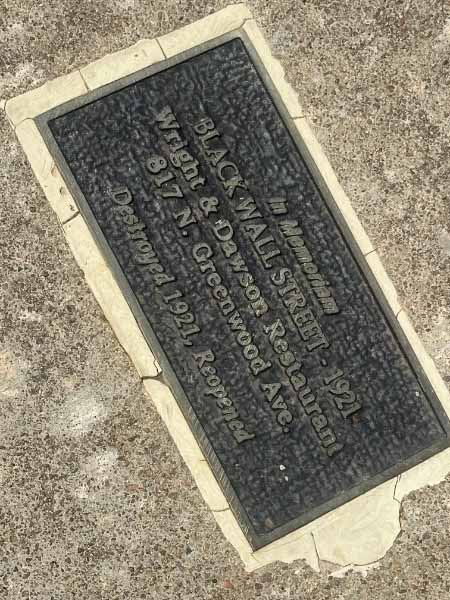
Markers on the sidewalks in the Greenwood District identify the businesses that once stood in now-empty spaces.
As I walked through Greenwood that week, I saw markers on the sidewalks identifying businesses that once stood in now-empty spaces. At the same time, I also saw new businesses rising and bringing life back into the district.
One of the most memorable moments for me was seeing thousands upon thousands of Black men and women gathered together in unity. On the first day, a registration clerk announced that 23,000 people had already registered online and that organizers expected nearly 100,000 attendees.
I was amazed. Throughout the week, there was joy everywhere — laughter, dancing, celebration, and peace. I did not witness a single fight or argument. Even when the rain came, nobody complained. In fact, people kept dancing in the rain.
The area was filled with Black-owned businesses, vendors and food trucks, and people had traveled from all across the country to be there. It was truly beautiful to witness.
The biggest lesson I took away from the experience is that, as Black people, we must learn our history.
If we can memorize every TikTok dance, every song lyric, every line dance and every step routine, then we should also make time to learn where we come from.
I am 50 years old and just now learning about the Tulsa Massacre. This history was never fully taught during my school years — and if it was, perhaps I was too distracted to understand its importance. Either way, we must wake up and educate ourselves. Maybe if we truly understood what our ancestors endured, we would appreciate and respect their sacrifices even more.
One final thought: appreciate the small things. Our ancestors endured unimaginable struggles and hardships so that future generations could have opportunities they never had. Sometimes I wonder what a conversation would sound like if Martin Luther King Jr., Thurgood Marshall, Malcolm X, Frederick Douglass, Rosa Parks and Harriet Tubman sat around a table together discussing us today. Would they be proud of how far we have come? Would they feel their sacrifices were worth it?
Or would they be disappointed by the way we sometimes treat one another within our own community?
Those are questions worth thinking about.